Wet Plate Test Camera for circular Images, c. 1870
Starting bid: € 600 | Estimate: € 900 – 1.200
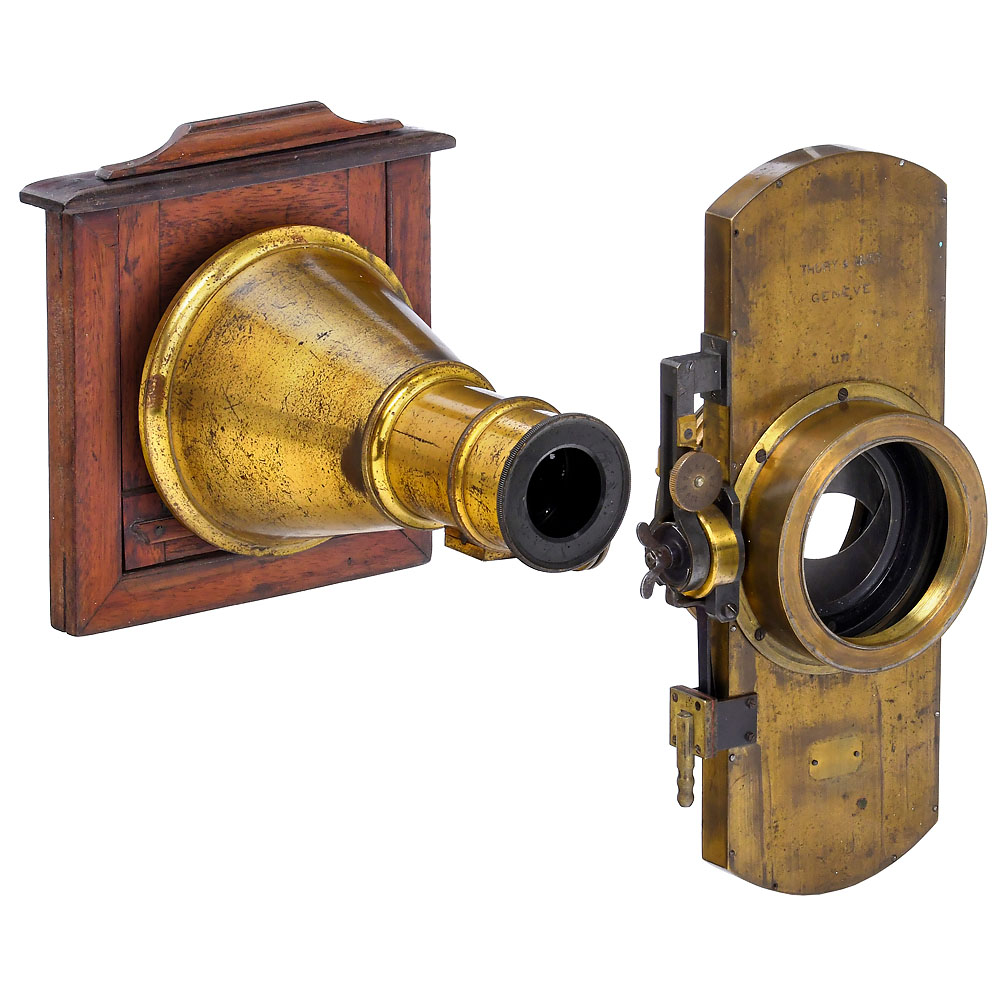
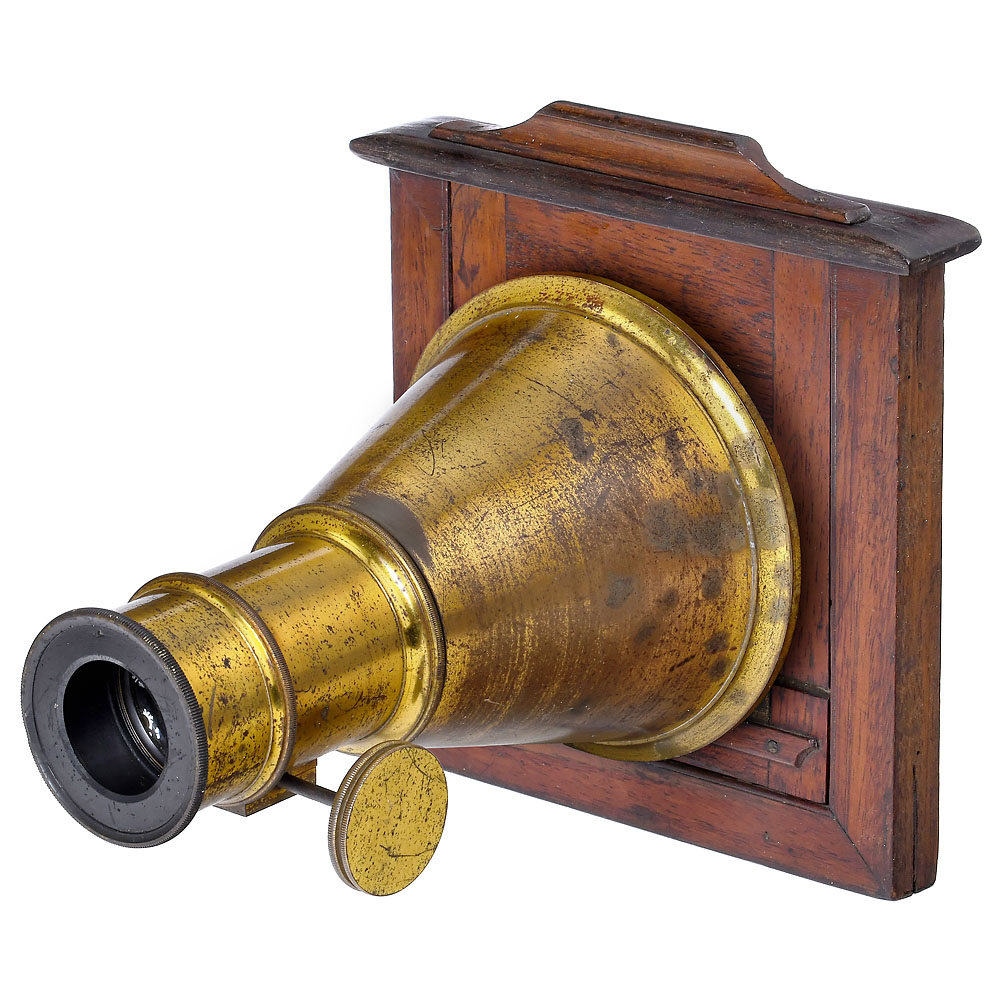
Probably of French or Swiss origin. The actual camera body is missing; it consisted of a thin connecting plate, approximately 10.5 mm thick, which was never recognized as part of a camera by later generations and therefore went missing. For reconstruction: This plate connected the conical brass lens mount to the wet plate studio cassette. The cassette holders were attached to the sides of this plate, and possibly, to balance the weight, a T-shaped piece was glued to the bottom of the plate as a base. A mounting ring of at least 124 mm diameter must have been attached to this plate. What remains: The cassette for 125 x 125 mm plates, with outer dimensions of 16.1 cm height and 16.0 cm width, and a 3 x 17.6 cm light-tight cover. The brass lens is unmarked (front lens with some cementing errors) and a Petzval type, c. 3.4/14 cm, with an early, removable front aperture diaphragm (a set of diaphragms must have been supplied), but without a Waterhouse stop. A focusing range of 41 mm is possible (one screw is missing). At infinity, the image circle is 85 mm in diameter; at close range, it reaches exactly 114 mm (without the vignetting front diaphragm), which corresponds to the thread diameter on the lens mount. Also includes: A very early, large brass shutter by Thury & Amey, Geneva, serial number 1173, for a lens diameter of approximately 54 mm; it is functional.
Naßplatten-Testkamera für kreisrunde Aufnahmen um 1870
Vermutlich aus Frankreich oder Schweiz. Es fehlt der eigentlicher Kamerakörper als ein dünnes Verbindungsbrett von etwa 10,5 mm Dicke, das von der Nachwelt nie als Kamera identifiziert wurde und daher verlorenging. Zur Rekonstruktion: Dies Brett verbindet den konischen Messing-Objektivhalter mit der Naßplatten-Atelierkassette. An diesem Brett kommen noch seitlich die Halter für die Kassette und eventuell wegen des Masseschwerpunkt war unten am Brett ein T-Stück als Bodenbrett angeleimt. Am Brett muß ferner ein Aufnahmering von mindestens 124 mm Durchmesser vorhanden gewesen sein. Vorhanden ist: Die Kassette für 125 x 125 mm Platten, Außenmaße 16,1 cm Höhe und 16,0 cm Breite mit einem Oberteil zum lichtdichten Abschließen von 3 x 17,6 cm. Die Messingoptik ist unbezeichnet und ein Petzval-Typ (Frontlinse mit etwas Kittfehler) von etwa 3,4/14 cm noch mit früher ausschraubbarer Vorderblende (es muß einen Blenden-Satz dazu gegeben haben), noch ohne Steckblendeneinrichtung, ein Auszug am Trieb (eine Schraube fehlt) von 41 mm ist möglich. Ausgeleuchtet wird auf Unendlich ein rundes Format von 85 mm Durchmesser, das im Nahbereich genau jene 114 mm (ohne die vignettierende Vorderblende) erreicht, die der Konus zur Kameraseite als Gewinde aufweist. Mit dabei war: Ein riesiger sehr früher Messingverschluß von Thury & Amey, Genève Nr. 1173 für Optikdurchmesser von etwa 54 mm, funktioniert.