
Auction: 12. September 2026
Philipp Graff Camera, c. 1848
Starting bid: € 1.200 | Estimate: € 2.000 – 4.000
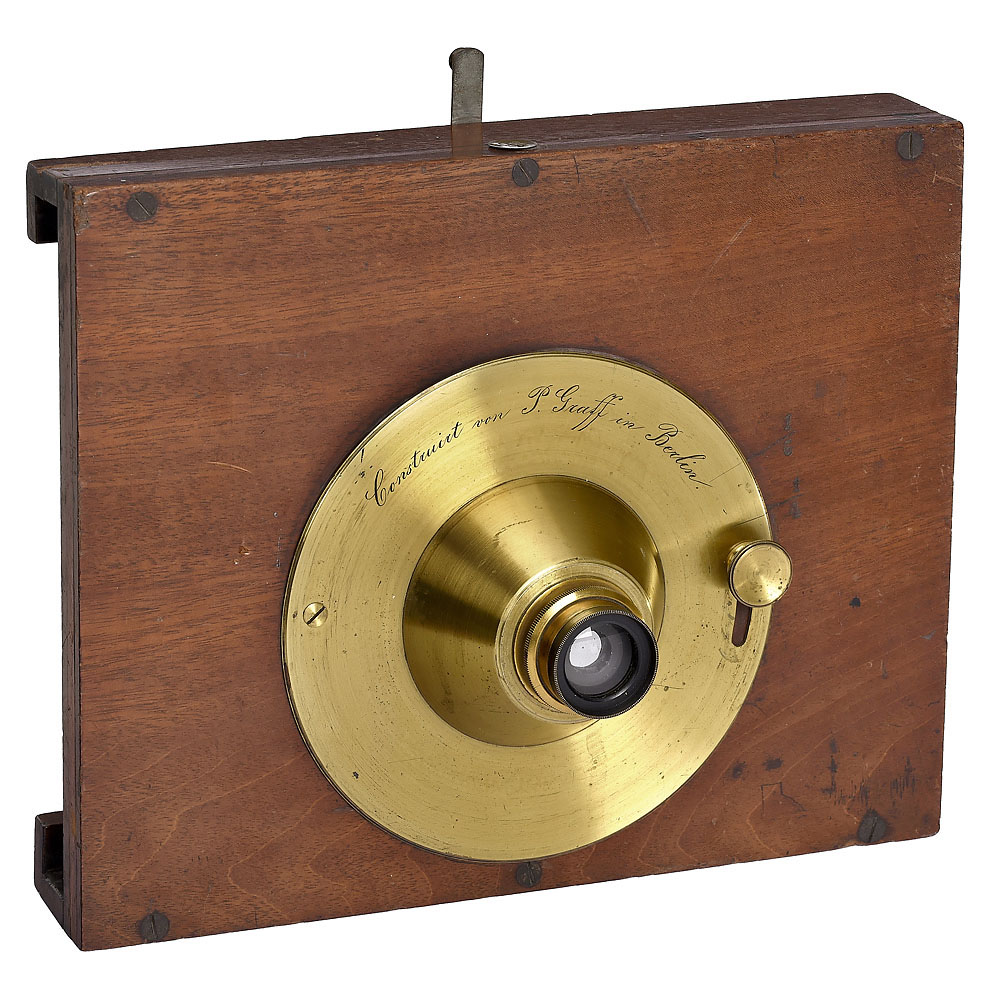
“Constructed by P. Graff in Berlin.” It features a rotatable brass disc – mounted on an axis and bearing an engraving – and a conical tube designed for a short focal length, set upon a flat camera front similar to the multi-back attachments found on later studio cameras. The front of the wooden body bears embossed markings: 1/6 and ¼. The rear features a hinged focusing screen measuring 67 x 130 mm, though the actual usable image area – by design – measures 55 x 85 mm. Along the top edge of the rear panel, markings are embossed to guide the sliding placement of a 16 x 21 cm studio plate holder: ¼, 2, 1, 3, 4. If this camera was indeed built during Graff’s lifetime (1813–1851), he may well have used it in 1848 – working as a daguerreotypist – to create portraits of the members of the Frankfurt National Assembly; the subtle embossing on the front served as his advertisement as a professional photographer. In this process, the smaller individual portraits were captured sequentially on a single full-sized plate; due to time constraints and the need for efficiency, up to eight exposures would be developed simultaneously. The original lens was later replaced in circa 1870 with an Aplanat lens (approximately 6/60 mm), which produces a sharp image at a distance of 8 meters; the original lens was likely a Petzval-type optic of the same focal length but with a wider aperture, equipped with a rack-and-pinion focusing mechanism, without tripod mount (broken, replaceable). This camera represents a historically significant artifact within the history of Germany.
Philipp Graff Camera um 1848
“Construiert von P. Graff in Berlin“. Um die Achse drehbare Messingscheibe mit Gravur und konischem Tubus für eine kurze Brennweite auf einer flachen Kamerafront ähnlich den späteren Atelierkamera-Multiplikator-Rückteilen. Vorne Prägung im Holz: 1/6 und ¼. Rückseite mit abklappbarer Mattscheibe 67 x 130 mm, wobei konstruktiv die reale Bildfläche 55 x 85 mm beträgt. Rückseitig oben für eine Atelierkassette 16 x 21 cm zum Verschieben geprägt: ¼ 2 1 3 4. Ist diese Kamera zu Lebzeiten Graffs gebaut (1813-1851), so kann er mit ihr als Daguerreotypist 1848 die Mitglieder der Frankfurter Nationalversammlung portraitiert haben, dazu mit der dezenten Werbung vorne für ihn als Photograph. Dann erfolgten die kleineren Einzelportraits alle nacheinander auf einer Ganzplatte, wo aus Zeitmangel und Schnelligkeit bis zu 8 Aufnahmen auf einmal entwickelt wurden. Die Optik wurde später um 1870 mit einem Aplanat von etwa 6/60 mm ersetzt und zeigt ein scharfes Bild bei 8 m Abstand, das Original kann ein Petzval-Typ von gleicher Brennweite und höherer Lichtstärke mit Trieb zum Fokussieren gewesen sein, ohne Stativaufnahme (abgebrochen, aber ersetzbar). Historisch wichtige Kamera zur Geschichte Deutschlands.