
Auction: 12. September 2026
Japanese Peepshow Box (Karakuri), c. 1890
Starting bid: € 1.600 | Estimate: € 2.000 – 4.000
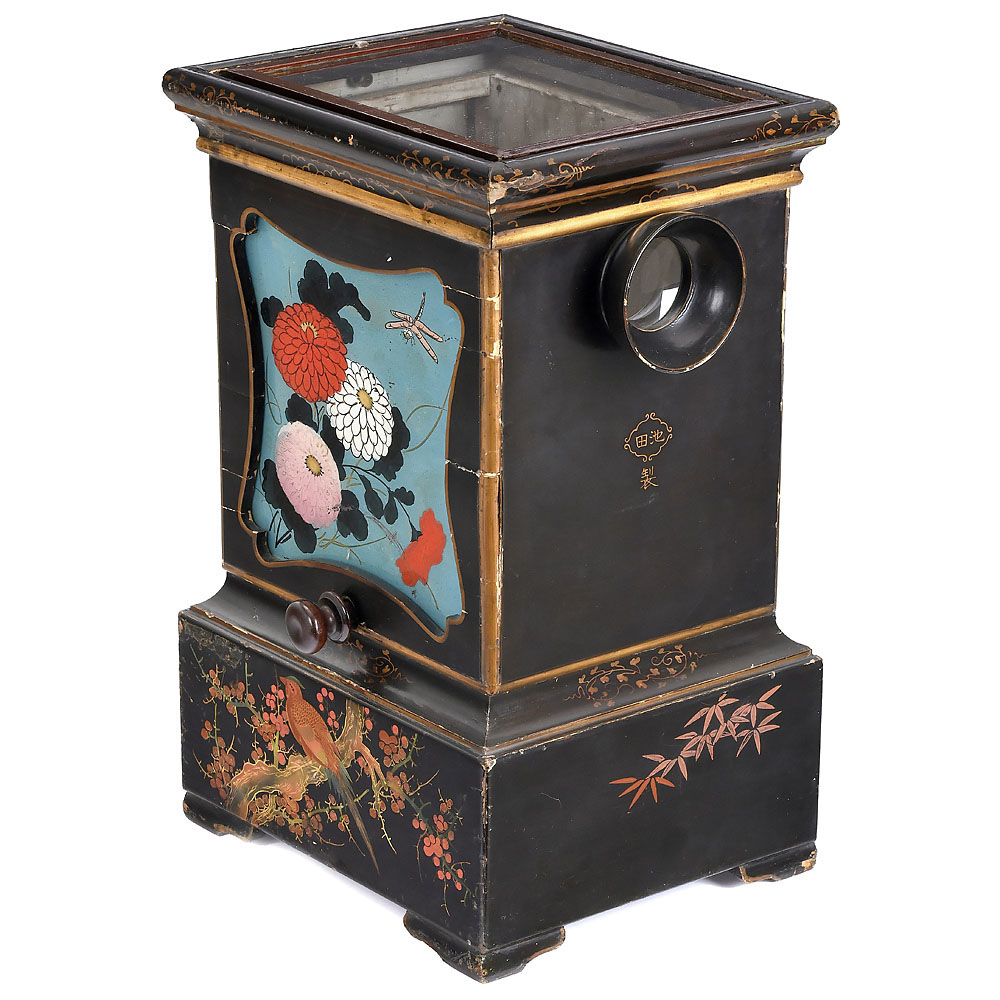
Ikeda, Japan. Following contact with Dutch merchants and their imported “Dutch machine” (the peepshow box), this form of viewing entertainment gained popularity in Japan during the late Edo period (1603–1867). The piece consists of a wooden box finished in black lacquer with decorative motifs, measuring 21.2 x 24.6 x 39 cm. Its side panels feature reverse-glass paintings of chrysanthemums; the glass on one side bears a crack. Designed for two viewers seated opposite one another, the device features fixed eyepieces; one viewer looks at a European image, while the other views a Japanese image. A striking mechanism sounds a chime each time the mechanism is rotated to display a new image. The device accommodates 48 pairs of photographs (up to a format of 6 x 11 cm), featuring subjects from Japan, Europe, and World’s Fairs; the images themselves are heavily faded. The top section consists of a removable frame (the base of which has been restored) fitted with a transparent glass pane (a similar viewer in the Akagi Kiyoshi Collection at the Edo-Tokyo Museum features a pane of frosted glass). Particularly striking is the pairing of these dual images, which invites contemplation on questions of identity and destiny – “Where are we headed? Who are we?” – as illustrated by the following examples: The Execution of Paris Communards (1871) paired with a serene, contemplative Buddha statue; a World’s Fair scene paired with a temple shrine; Venice paired with a mangrove jungle; and the Crystal Palace in London paired with a scene depicting the natural beauty of Japan. An extraordinarily rare device, offering a compelling visual narrative of Asia’s transition into the modern era.
Japanischer Guckkasten Karakuri um 1890
Ikeda, Japan. Nach dem Kontakt zu den niederländischen Kaufleuten und ihrer importierten “holländischen Maschine“ (der Guckkasten) wurde in der späten Edo-Periode (1603-1867) diese Betrachtungsform populär in Japan. Holzkasten in Schwarzlack mit Dekor, 21,2 x 24,6 x 39 cm, Seitenflächen mit Hinterglas-Malerei von Chrysanthemen, eine Seite Glas mit Sprung, für zwei gegenüberliegende Betrachter mit fest montiertem Okular, wobei der eine Betrachter auf ein europäisches Bild sieht, der andere auf ein japanisches Bild. Nach jedem Drehen für ein neues Bild ertönt ein Schlagwerk, für 48 Doppel-Photographien bis zum Format 6 x 11 cm, Motive aus Japan und Europa und Weltausstellungen, Bilder stark verblasst, die Oberseite besteht aus einem abnehmbaren Rahmen (Unterteil erneuert) mit einer transparenten Glasscheibe (im Edo-Tokyo Museum die Akagi Kiyoshi Kollektion zeigt ein ähnlicher Betrachter eine Milchglasscheibe). Auffällig ist die Kombination der Doppelbilder zum Nachsinnen, wohin wollen wir, wer sind wir – ein Auszug: Exekution 1871 Kommunarden Paris – Gegenseite: in sich ruhende Buddha-Statue, Weltausstellung – Gegenseite: Tempelschrein, Venedig – Gegenseite: Mangrovendschungel, Kristallpalast London: – Gegenseite Naturschönheit Japans. Außerordentlich seltenes Gerät, eindrucksvoll den Weg Asiens in die Neuzeit zeigend.