
Auction: 16. May 2026
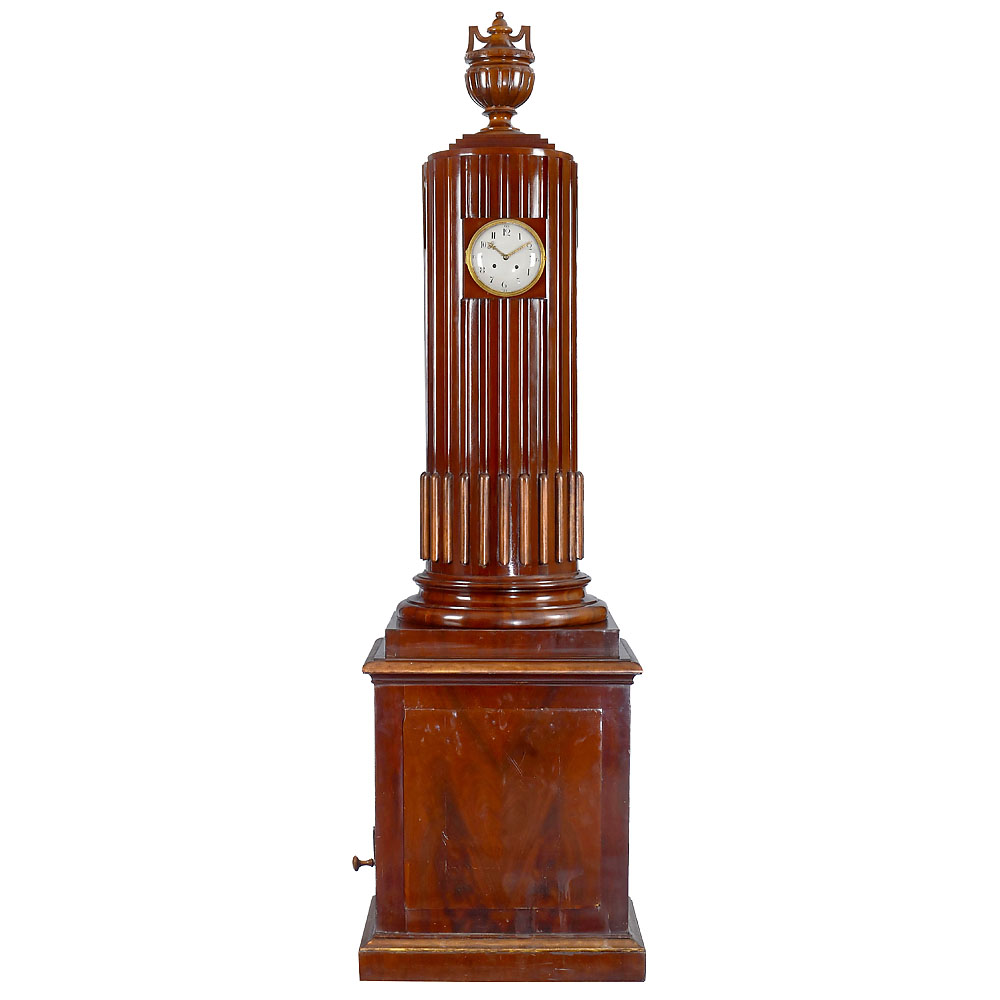
Rare Empire Timepiece with Organ, c. 1800
Starting bid: € 7.500 | Estimate: € 12.000 – 15.000
By Christian Ernst Kleemeyer, Berlin. With weight-driven brass organ movement, 1-air 14 ¾-inch (37,5 cm) pinned wood barrel with 31 pipes in two rows, enameled Arabic dial, Ø 7 in., two-train time movement, hour strike on bell, cherry wood case, size 27 x 19 5/8 x 99 in. Working, plays a bit somewhat softly. – Attributed to Christian Ernst Kleemeyer (born c. 1739), court clockmaker to the Prussian king Friedrich Wilhelm II. – Organ clocks by Kleemeyer are to be found in the Museum of Musical Instruments of the University of Leipzig and the Musical Instrument Museum in Berlin. Signed examples of his work include musical secretaires and clocks with architectural elements, such as the example seen here. –Literature: Helmut Kowar, “Mozart and Mechanical Music”, in: “Journal of Mechanical Music”, Spring 1992, p. 27, for a very similar (if not identical) piece. – An early and impressive instrument worthy of exhibition.
Seltene Flötenuhr in Berliner Bauart, um 1800
Klassizistische Flötenuhr, Hersteller Christian Ernst Kleemeyer, Berlin. Messing-Orgelmechanik mit Gewichtantrieb, bestiftete Walze (37,5 cm) für 1 Melodie, 31 Pfeifen in 2 Reihen, 2-zügiges Uhrwerk mit emailliertem Zifferblatt mit arabischen Zahlen, Ø 18 cm, Stundenschlag auf Glocke, Kirschbaumgehäuse, 69 x 50 x 250 cm. Funktioniert, spielt aber etwas leise. – Flötenuhren von Kleemeyer (* um 1739, Hofuhrmacher am Hof Friedrich Wilhelms II.) sind in den Musikinstrumenten-Museen in Berlin und der Universität Leipzig zu sehen. – Literatur: Helmut Kowar, “Mozart and Mechanical Music”, in: “Journal of Mechanical Music”, Frühjahr 1992, S. 27, für ein sehr ähnliches Instrument. – Eine frühe und beeindruckende Flötenuhr.