
Auction: 16. May 2026
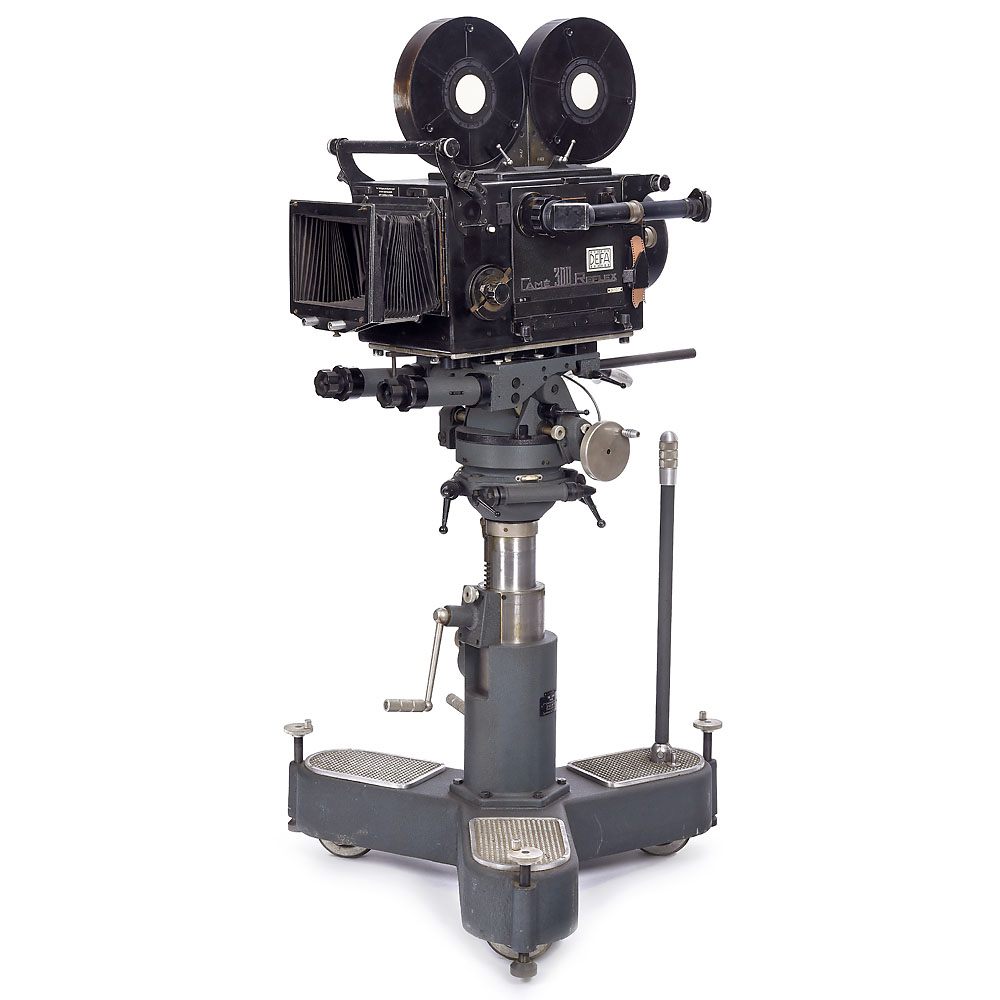
Camé-300 Reflex, circa 1955
Starting bid: € 6.900 | Estimate: € 9.000 – 14.000
Eclair Studio, Paris. Low-noise 35mm film camera for feature films. Objectiv: Angenieux S2 1,8/28 mm. Viewfinder system: single-lens reflex via a prism magnifying lens, interchangeable with a second magnifying lens on the camera for viewing the image on the film back (film as ground glass system). On the camera: viewing window for focus scale and frame counter. Aperture control knob with interchangeable scales corresponding to the respective lens focal length. Cutter for the film end. Front: large bellows. Two cassettes for 300m of film on the camera. Inside the body: stepping mechanism with claw and locking claw. Drive by an interchangeable three-phase synchronous motor. Condition camera (3/3). Tripod: the original Eclair crank and wheel tripod for this camera type with the universally adjustable Gyroflex head. Condition tripod (2/2). – A camera from the archives of the famous Babelsberg film studios. This largest European studio complex was taken over in 1946 by DEFA-Studio für Spielfilm AG, the largest German film company of the post-war period. Under pressure to modernize (for example, with Cinemascope), DEFA purchased two Camé 300 Reflex cameras in Paris in 1956 for the films “Spielbankaffäre” and “Mutter Courage.” They were decommissioned around 1976. – Electrical functions not tested.
Camé-300 Reflex, um 1955
Etablissement Eclair, Paris. Geräuscharme 35 mm-Filmkamera für Spielfilmaufnahmen. Objektiv: Angenieux S2 1,8/28 mm. Suchersystem: Spiegelreflex über eine Prismenfernrohrlupe, wechselbar für eine zweite Lupenöffnung an der Kamera zur Betrachtung des Bildes auf der Filmrückseite (System Film als Mattscheibe). An der Kamera: Einblickfenster für Schärfenskala und Métrage-Zähler. Drehknopf für Blendenverstellung mit auswechselbaren Skalen entsprechend der jeweiligen Objektivbrennweite. Anschneider für das Filmende. Frontseitig: großes Balgenkompendium. Auf der Kamera zwei Kassetten für 300 m Film. Im Gehäuse Schrittschaltwerk mit Greifer und Sperrgreifer. Antrieb durch auswechselbaren Drei-Phasen-Synchronmotor. Zustand Kamera (3/3). Stativ: das für diesen Kameratyp originale Eclair-Kurbel- und Fahrstativ mit dem universal verstellbaren Gyroflex-Kopf. Zustand Stativ (2/2). – Eine Kamera aus den Beständen der berühmten Babelsberger Filmstudios. Diesen größten europäischen Studiokomplex übernahm 1946 das DEFA-Studio für Spielfilm AG, die größte deutsche Filmgesellschaft der Nachkriegszeit. Unter dem Modernisierungsdruck (zum Beispiel Cinemascope) kaufte die DEFA für die Filme „Spielbankaffäre“ und „Mutter Courage“ 1956 in Paris zwei „Camé-300-Reflex“-Kameras. Gegen 1976 wurden sie ausgemustert. – Elektrische Funktionen nicht geprüft.