
Auction: 16. May 2026
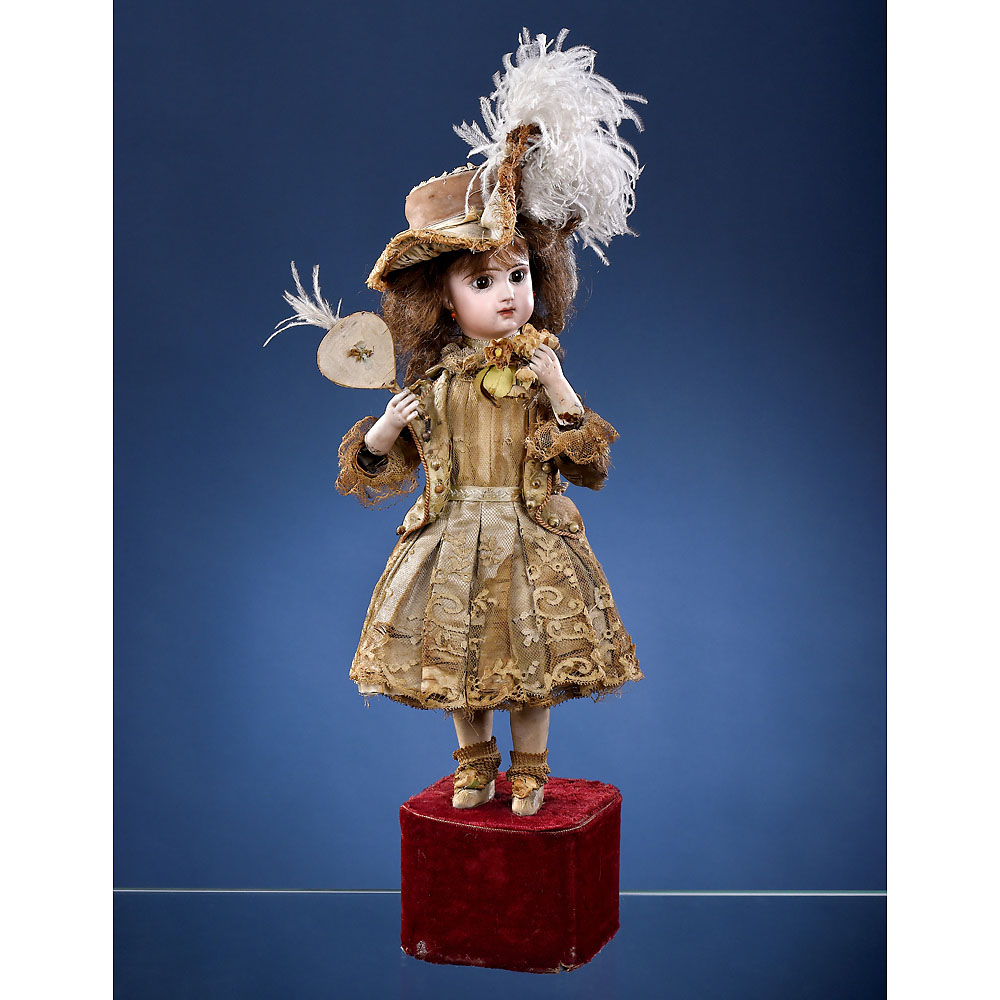
“Bébé Eventail” Musical Automaton by Leopold Lambert, c. 1895
Starting bid: € 1.600 | Estimate: € 2.000 – 3.500
With Jumeau bisque head stamped “Déposé Tête Jumeau 4”, closed mouth, fixed brown paperweight eyes, pierced ears with earrings, cork pate, brown hair wig, bisque hands holding a bouquet and fan, on velvet-covered base with going-barrel movement playing a single air (“La Czarine”) as the figure turns and inclines her head, twists the fan and raises the flowers, in original two-piece eau de nil satin costume with lace overlay and matching feathered hat, ht. 21 in. (53 cm) to top of hat, with JC (Jules Cuendet) tune-sheet, monogrammed brass LB key and stop / start, working and playing condition, jacket worn, discoloration in the bisque – presumably from the time of manufacture – on base of neck (covered by silk band) and hands.
Note: A French automaton with expressive bisque head by Emile Jumeau and couturier costume from the workshop of Eugénie Bourgeois Lambert. The choice of music, “La Czarine” by Louis Ganne, published in orchestral form in 1893, shows a maker at the height of his creative success and keen to keep up to date with the latest trends.
Literature: Bailly, “Automata, the Golden Age”, pp. 183, 344.
Musik-Puppenautomat “Bébé Eventail“ von Leopold Lambert, um 1895
Mit einem Biskuitporzellan-Kopf von Jumeau, geprägt mit „Déposé Tête Jumeau 4“, geschlossenem Mund, braunen Paperweight Augen, durchstochenen Ohren mit Ohrringen, braune Haarperücke auf Korkdeckel, Biskuitporzellan-Hände, die einen Blumenstrauß und einen Fächer halten, auf samtbezogenem Sockel mit Federwerk, das eine einzige Melodie („La Czarine“) spielt, während sich die Figur dreht und den Kopf neigt, den Fächer dreht und die Blumen hebt, im originalen zweiteiligen Kostüm aus Satin in Eau-de-Nil-Farbe mit Spitzenüberzug und passendem Federhut, Höhe 53 cm bis zur Hutspitze, mit JC (Jules Cuendet) Notenblatt, monogrammiertem Messing-LB-Schlüssel und Start-/Stoppknopf, funktions- und spielfähig, Jacke abgenutzt, Verfärbungen im Biskuitporzellan – vermutlich aus der Herstellungszeit – am Halsansatz (durch Seidenband verdeckt) und an den Händen.
Anmerkung: Ein französischer Automat mit ausdrucksstarkem Bisquitkopf von Emile Jumeau und einem Couturier-Kostüm aus der Werkstatt von Eugénie Bourgeois Lambert. Die Wahl der Musik, „La Czarine“ von Louis Ganne, 1893 in Orchesterfassung veröffentlicht, zeugt von einem Hersteller auf dem Höhepunkt seines kreativen Erfolgs, der bestrebt war, mit den neuesten Trends Schritt zu halten.
Literatur: Bailly, “Automata, the Golden Age“, S. 183, 344.